
The TCF Canada (Test de connaissance du français pour le Canada) is the French proficiency exam recognized by Immigration, Refugees and Citizenship Canada (IRCC) for permanent residence and citizenship applications. It is administered by France Éducation International (FEI). This page shows the complete score conversion between TCF Canada raw scores, CEFR levels (A1 through C2), and the Canadian Language Benchmarks (CLB) / Niveaux de compétence linguistique canadiens (NCLC) 1–12 scale.
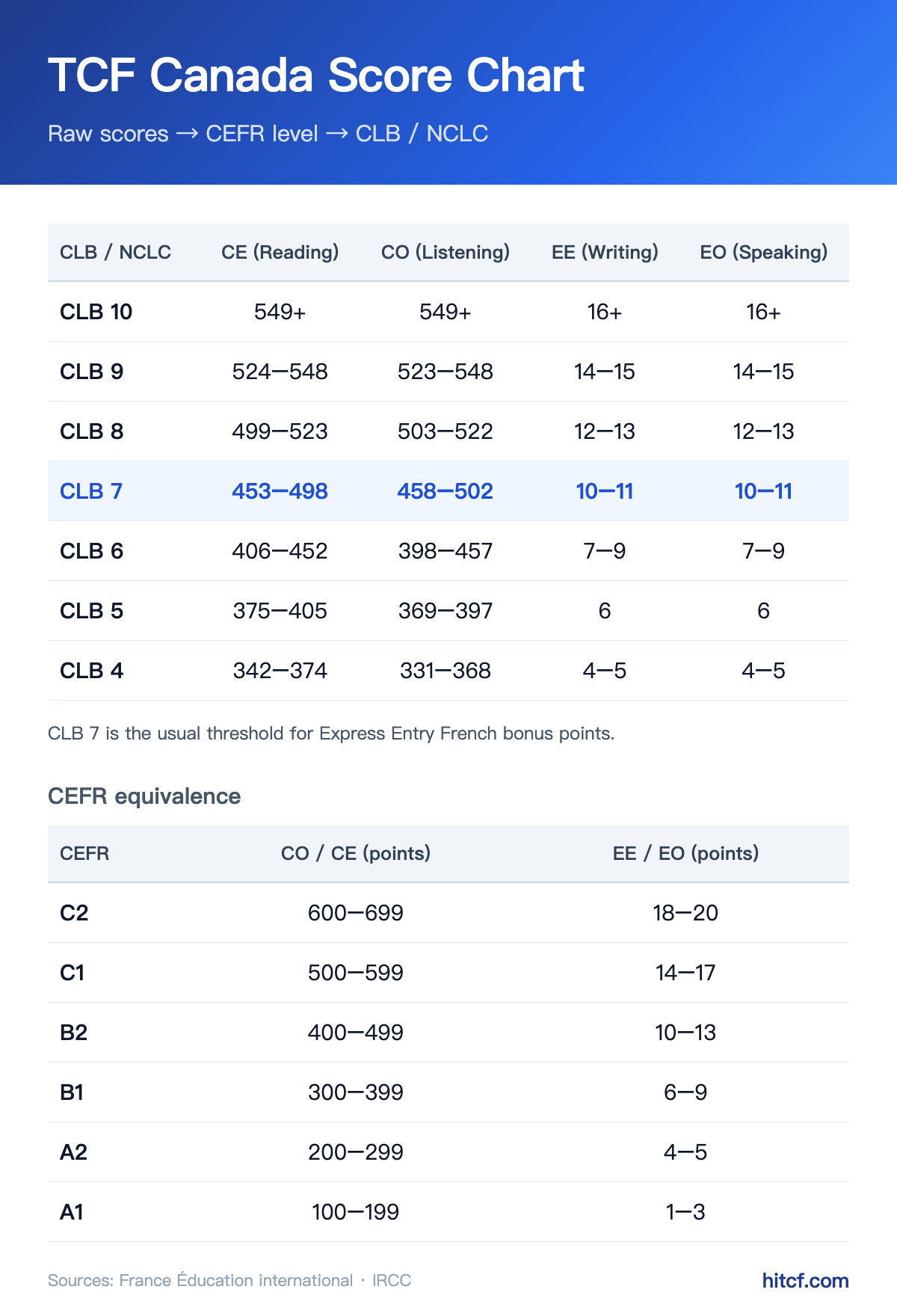
TCF Canada score chart — raw scores, CEFR levels and CLB / NCLC equivalence.
TCF Canada score chart — raw scores, CEFR levels and CLB / NCLC equivalence.
Last updated : 2026-04-05. Source tables below are published by IRCC and FEI. HiTCF is an independent third-party practice platform and is not affiliated with IRCC or FEI.
How TCF Canada is scored
TCF Canada has four mandatory sections, each scored independently:
| Section | Format | Questions | Duration | Score range |
|---|---|---|---|---|
| Compréhension Orale (CO) — Listening | Multiple choice | 39 | 35 min | 100–699 |
| Compréhension Écrite (CE) — Reading | Multiple choice | 39 | 60 min | 100–699 |
| Expression Écrite (EE) — Writing | 3 tasks | — | 60 min | 0–20 |
| Expression Orale (EO) — Speaking | 3 tasks | — | 12 min | 0–20 |
There is no overall total. Each skill is reported separately and mapped to its own CEFR level. To qualify for a given CLB level (for Express Entry or PEQ), you must reach the minimum score in every skill.
TCF Canada score → CEFR level
The raw CO/CE score maps to CEFR as follows (published by FEI). The EE/EO mapping uses the 0–20 scale directly.
| CEFR level | CO / CE (points) | EE / EO (points) |
|---|---|---|
| C2 — Mastery | 600–699 | 18–20 |
| C1 — Advanced | 500–599 | 14–17 |
| B2 — Upper intermediate | 400–499 | 10–13 |
| B1 — Intermediate | 300–399 | 6–9 |
| A2 — Elementary | 200–299 | 4–5 |
| A1 — Beginner | 100–199 | 1–3 |
TCF Canada score → CLB / NCLC (official IRCC table)
This is the table IRCC uses for Express Entry and all federal immigration programs. See the official IRCC language testing reference for the authoritative current version.
| CLB / NCLC | CE (Reading) | CO (Listening) | EE (Writing) | EO (Speaking) |
|---|---|---|---|---|
| CLB 10 | 549+ | 549+ | 16+ | 16+ |
| CLB 9 | 524–548 | 523–548 | 14–15 | 14–15 |
| CLB 8 | 499–523 | 503–522 | 12–13 | 12–13 |
| CLB 7 | 453–498 | 458–502 | 10–11 | 10–11 |
| CLB 6 | 406–452 | 398–457 | 7–9 | 7–9 |
| CLB 5 | 375–405 | 369–397 | 6 | 6 |
| CLB 4 | 342–374 | 331–368 | 4–5 | 4–5 |
Note: CLB (Canadian Language Benchmarks) and NCLC (Niveaux de compétence linguistique canadiens) are the same scale applied to English and French respectively. NCLC 7 = CLB 7. Every CLB threshold above applies to TCF Canada regardless of the term used.
Confused that NCLC 8 maps to B2 and not B1? Read the deep-dive on why NCLC and CEFR don't line up 1:1. Now that you know the target, see what CLB 7 takes in each skill and the 30-day study plan for getting there.
What score do you need for Canadian PR?
Express Entry — Federal Skilled Worker (FSW)
You need a minimum of CLB 7 in all four skills in either English or French to be eligible for the Federal Skilled Worker Program. French also earns additional CRS points, and which language you declare as your first official language doesn't matter — only your scores do: NCLC 7 or higher in all four French skills plus CLB 5 or higher in all four English skills gives 50 points; NCLC 7+ in French with CLB 4 or lower in English (or no English test) gives 25 points. A candidate with English as their first official language and French as their second still qualifies for the full 50.
Quebec Skilled Worker (QSW) / PEQ
Quebec programs require a minimum of NCLC 7 in oral skills (CO + EO). For some streams, NCLC 5 in written skills (CE + EE) is sufficient. The Programme de l'expérience québécoise (PEQ) also accepts NCLC 7 in oral comprehension and production.
Canadian citizenship
Citizenship requires CLB 4 in speaking and listening (EO and CO). Writing and reading are not tested for citizenship applications, but demonstrated proficiency through education or employment is considered.
How HiTCF helps you hit these benchmarks
HiTCF offers 1,800+ test sets and 7,800+ questions covering every CEFR level from A1 through C2:
- 144 listening test sets (956 CO questions) with sentence-level audio timestamps — every sentence can be replayed independently.
- 140 reading test sets (1100 CE questions) with click-to-lookup vocabulary and full explanations for every answer.
- 983 speaking topic sets (3983 EO tasks across Tâche 1, 2, and 3) with AI scoring on 6 criteria broken down from FEI's three official categories.
- 583 writing task sets (1744 EE tasks) with AI feedback on 6 criteria broken down from FEI's three official categories (linguistic / pragmatic / sociolinguistic).
Every practice question shows an estimated CEFR level and the corresponding CLB/NCLC band, so you can track exactly where you stand against the benchmarks above. New users can practise two full listening sets and two reading sets free, plus 5 questions a day — no credit card required.
Why everyone also wants to know the CEFR letter
CEFR (Common European Framework of Reference for Languages) is the international 6-level scale: A1 → C2. Most French learners encounter A1/A2/B1/B2/C1/C2 first, especially through DELF / DALF certificates which are issued in CEFR directly. So when TCF candidates see "NCLC 8" they immediately want the CEFR equivalent.
The catch: NCLC and CEFR are not 1:1
- NCLC / CLB: 12 levels (1–12), three broad stages, four sub-levels each
- CEFR: 6 levels (A1, A2, B1, B2, C1, C2), three broad stages, two sub-levels each
Each CEFR level roughly maps to ~2 NCLC levels, but not as a clean split:
| CEFR | Approximate NCLC |
|---|---|
| C2 | 11–12 |
| C1 | 9–10 |
| B2 | 7–8 |
| B1 | 5–6 |
| A2 | 3–4 |
| A1 | 1–2 |
So 13 (NCLC 8) lands in B2, not B1.
CCLB (Centre for Canadian Language Benchmarks) published a 233-page CLB-to-CEFR alignment study in 2019 with this verbatim disclaimer: "There is no official or exact equivalence between CLB and CEFR levels." The two scales rest on different descriptor systems, and what alignment exists is "validated comparable" — not stamped 1:1. Every NCLC ↔ CEFR conversion table you see is industry consensus, not a regulation.
Why IRCC uses CLB/NCLC instead of CEFR
Three practical reasons:
- One axis for many tests. IRCC accepts CELPIP, IELTS, PTE, TEF and TCF — five tests, five different raw-score scales. CLB normalizes them onto a single 0–12 integer axis. CEFR's 6 levels are too coarse to differentiate Express Entry CRS thresholds.
- CRS scoring needs 12 buckets. The Express Entry points table awards different scores at CLB 5, 7, 9, 10. With CEFR's 6 levels you can't draw those lines.
- English/French symmetry. CLB (English) and NCLC (French) are the same ruler with two names — fitting Canada's bilingual constitution. CEFR is European-flavoured; outsourcing immigration language standards to the Council of Europe was never on the table.
A common misread
"NCLC 8 sounds like a middling level, so it's B1 right?"
No. The number-to-letter mapping isn't intuitive from the digits. Across NCLC 1–12:
- 1–4 covers basic users (A1–A2)
- 5–8 covers intermediate to upper-intermediate (B1–B2)
- 9–12 covers advanced to mastery (C1–C2)
So NCLC 8 is already upper B2 — you can hold a fluent discussion on complex topics. Federal Skilled Worker only requires NCLC 7 (lower B2) to claim full points, so NCLC 8 is a strong result.
Verify the originals
- IRCC equivalency chart (all skills) — the authoritative source for NCLC 8 = 12–13
- Express Entry: language test results
- Centre for Canadian Language Benchmarks — publisher of the NCLC ↔ CEFR alignment study
- France Éducation International — TCF Canada — TCF test designer
Next time someone tells you a 13 is B1, send them this page.
Frequently asked questions
What TCF Canada score do I need for CLB 7?
CLB 7 requires: Compréhension Écrite 453–498 points, Compréhension Orale 458–502 points, Expression Écrite 10–11 points, and Expression Orale 10–11 points. CLB 7 is the minimum French proficiency required for most Express Entry federal skilled worker programs and for full bilingual points on CRS.
Is NCLC the same as CLB?
Yes. NCLC is the French-language equivalent of CLB, using the same 1–12 scale. NCLC 7 = CLB 7. IRCC reports both terms interchangeably depending on whether the test was in French (NCLC) or English (CLB).
How is TCF Canada different from TCF?
TCF Canada is a special version of the Test de Connaissance du Français designed specifically for the Canadian immigration and citizenship context. All four skills (CO, CE, EE, EO) are mandatory, scored with the Canadian scale, and recognized by IRCC. The regular TCF tests vary by version and are used for other purposes (academic admission, visa applications, etc.).
How long are TCF Canada scores valid?
TCF Canada scores are valid for two years from the date of the exam. After two years, you must retake the test to submit a new Express Entry profile or other IRCC application.
Where can I take TCF Canada in Canada?
TCF Canada is offered at accredited Alliance Française centres in Ottawa, Calgary, Vancouver, Toronto, Montreal, and several other Canadian cities. Seats are limited and fill quickly — HiTCF provides a real-time seat monitor for Ottawa, Calgary, and Vancouver that refreshes every 15 seconds.
Sources : France Éducation International — TCF Canada, IRCC — Test results and CLB levels. This page is maintained by HiTCF, an independent TCF Canada practice platform. We are not affiliated with IRCC or FEI. Please verify with the official sources for the most up-to-date thresholds before submitting your application.